The Team will be expected to maintain, enhance
and protect the system. In maintaining the system, the mentee will fix more
bugs that have not been found in the development of the system and the run time
errors. The mentee will also enhance the system when the situation calls for
it, such as the required alterations to adapt to the changing environment and
individual user. The mentee are expected to protect the system through security
modules and improve the functionalities until an error-free system is achieved.
Anrem J. Balontong is a student of Doctor of Information Technology program of Technological Institute of the Philippines, Quezon City. He is currently enrolled in DITCC 106 - Industry Immersion course this summer term of 2018.
Friday, June 1, 2018
WEEK 5- DESIGNING CUSTOMER EVALUATION
The mentee
will conduct a post implementation review to validate the completion of project
objectives and assess project management activities such as survey or interview
of all personnel actively involved in the operational use of the Faculty
Ranking System to get the feedback for further improvement of the system. If the client will be satisfied with the
result it will proceed to the deployment of the system but if not, it will then
be modified to ensure the efficiency of the program and to further enhance
depending on the client’s needs.
SETTING UP THE ENVIRONMENT.
SETTING UP
THE ENVIRONMENT. You need
workstations, development tools, a work area for the team. You don't need
access to all of these resources right away, although at the start of the
project you will need most of them.
WEEK 4. Starting to build the team
WEEK 4. Starting
to build the team. Although the
trainee will evolve over time, at the beginning of a development project you
will need to start identifying key team members and start bringing them onto
the team.
Modeling an
initial architecture for the system.
Early in the project you need to have at least a general idea of how you're
going to build the system. The developers on the project will get together in a
room, often around a whiteboard, discuss and then sketch out a potential
architecture for the system. This architecture will likely evolve over time, it
will not be very detailed yet (it just needs to be good enough for now), and
very little documentation (if any) needs to be written. The goal is to identify
an architectural strategy, not write mounds of documentation. You will work
through the design details later during development cycles in model storming
sessions and via TDD.
The Concept Phase: PRE-PROJECT PLANNING
The Concept Phase, sometimes called Iteration
-1, is the pre-project aspects of portfolio management. During this phase you
will:
Define the
business opportunity
Identify a
viable for the project
Assess the
feasibility
In this phase the mentee has the goal to
determine the problem to fix in the current manual system of the HRD. At first, the trainee had an interview with
the Human Resource Manager to have an idea about the operations in HRO are
being done. Some documents necessary for
the project are given to the trainee for further understanding. Based on the
interview and documents, the trainee looked for an applicable solution and
visits the HRM to assure if the proposed solution is applicable for the actual
need
Inception/Warm
Up: PROJECT INITIATION
The first week or so of an agile project is
often referred to as "Iteration 0" (or "Cycle 0") or in The
Eclipse Way the "Warm Up" iteration. The trainee’s goal during this
period is to initiate the project by:
Garnering initial support and funding
for the project. This may have been already achieved via your portfolio
management efforts, but realistically at some point somebody is going to ask
what we are going to get, how much is it going to cost, and how long is it
going to take. You need to be able to provide reasonable, although potentially
evolving, answers to these questions if you're going to get permission to work
on the project. You may need to justify your project via a feasibility project.
WEEK 3 - The Process
At First Glance
Together with Mr. John Tadifa, he
introduce me to the Information Technology Staff of Panay Electric Company.
Acceptance
Mr. Tadifa, An
Information Technology Manager, received and approve my Endorsement Letter and
Acceptance Form, together with Mentorship Blueprint.
All About PECO
Panay Electric Company (PECO) has been serving
the valued consumers of Iloilo City since 1923. It was then incorporated by the
following, Don Esteban De la Rama, Jose Ma. Arroyo, a former senator and after
whom the Arroyo Fountain in front of the capitol was named; lawyer Mariano
Jalbuena, Emiliano Lizares, Jose Lopez-Vito, Modesto Ledesma, Marcos Alfaras,
Jose Tiongco, Yap Seng, Eulogio Hernandez, Jose L. Jalbuena, Jose G. Paramos,
and G.M. Saul.
As of today PECO has been working on numerous
internal and external improvements to match the boom happening in Iloilo City.
The Power Distribution Set-Up explains the latest developments with PECO’s
operations as it grows in a healthy manner. Major investors such as Mega World,
Ayala and Gaisano groups are now investing heavily in the Iloilo and the power
demand has dramatically increased since 2014 by 5 to 10 megawatts yearly. PECO
has been very active in catering to the City’s power needs and has a bright
future mapped out with all the positive events happening lately in Iloilo City.
Week 2: The Company Endorsement
Selecting the RIGHT PATH
There are many options for my industry
immersion is either apply to outsourcing company Peco, Teletech Information
Technology Department, West Visayas State University in the region. I could request for their existing
data, do some data analytics, and come up with some meaningful interpretations
that could reveal something new or useful for them.
So in preparation for the most academically
challenging phase of my life I am now in the process of promising to minimize
my academic duties in my home school and close all my remaining external
projects.
I have choose the outsourcing solution of
PECO, at First, the Information Technology Manager, Mr. John B. Tadifa have
introduced me to his I.T. Staff, this include, the System Administrator, the
Network Administrator, Programmer and the Computer Technician.
WEEK 1 – THE JUMP-UP START (ORIENTATION)
Week 1 of the Immersion
As guided by our study plan, I enrolled in DITCC 106 - Industry Immersion course this summer term of 2018. Our professor in this summer course is no other than our supportive dean, Dr. Ruji P. Medina. The enrollment process went smoothly for the staffs of TIP were very helpful and competent. Our first day of class were all about orientation on DITCC 106 - Industry Immersion course. Our professor, Dr. Ruji P. Medina, laid out the following course objectives that he expected for us to achieve:
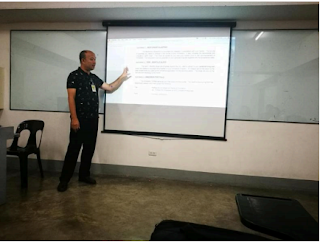
Dr. Medina conducted an orientation among Doctor of Information Technology and Doctor of Engineering students regarding the requirements for the Immersion Course and the expected deliverables, and one of those is of course is this blog. Apply and appreciate the relevance of classroom learning to the actual work setting; Compare his current work settings with other industries; Learn and adopt from industries best practices that produce outcomes; Imbibe knowledge, skills, and attitudes necessary to be effective practitioners and consultants; Produce a quality research paper Dr. Ruji P. Medina, Dean of Graduate Programs, conducted an orientation meeting on DITCC 106 - Industry Immersion course. By the end of our summer term, the list below are the following deliverables that we must submit in order to pass the course. Mentorship Blueprint Weekly Blog Immersion Portfolio Research Compendium Dean Medina encouraged us to go out of our comfort zone and seek companies that could offer industry experience that is most relevant to our intended dissertation paper, even if it meant living away from home for a whole month. I will be pondering about this recommendation as soon as I fly back home to Iloilo City.
Dr. Medina emphasized that industry immersion is a vital and indispensable component of graduate education. Through this, the student will be able to obtain experiential learning. Furthermore he pointed out that through immersion the student will be able to gain valuable exposure on the latest technologies and processes used in actual industry that will serve to validate the theoretical perspectives learned in school. He encouraged students to look for a bigger company with excellent IT Infrastructure in order to have a meaningful experience and relevant application of the skills learned in school. He also advised the students to be innovative and contribute also to the company by conducting research and apply those in the actual work setting and introduce new concepts that can be used by the company.
Subscribe to:
Posts (Atom)
THE LAST DAY – The Finishing Touch…..
THE LAST DAY – The Finishing Touch….. In the last day of the duty, my Mentor, Mr. John Tadifa, check the Mentorship Blueprint and bas...
-
Panay Electric Company (PECO) has been serving the valued consumers of Iloilo City since 1923. It was then incorporated by the following...
-
WEEK 3 - During the duty hours, the Head of Office assigned the Mentee a very delicate assignment which is designing, adopting and imple...